The island kingdom of Lankā, reborn in the light of the Dhamma brought by Arhant Mahinda, hummed with a new kind of yearning. King Devānampiyatissa reigned in the magnificent city of Anurādhapura, but it was the women of the court, led by the noble Queen Anulā, who felt the sharpest edge of spiritual longing. Queen Anulā …

The island kingdom of Lankā, reborn in the light of the Dhamma brought by Arhant Mahinda, hummed with a new kind of yearning. King Devānampiyatissa reigned in the magnificent city of Anurādhapura, but it was the women of the court, led by the noble Queen Anulā, who felt the sharpest edge of spiritual longing.
Queen Anulā had heard the sublime teachings. She had seen the tranquility of the newly ordained monks. But she and her five hundred royal companions stood at the precipice of the path, unable to cross. The Buddha had established a refuge for all—the four-fold Saṅgha—but the women of Lankā lacked the one necessary guide: a fully ordained Bhikkhunī (nun) to confer the higher vows.
A plea ascended from the heart of Lankā to the great Ashoka in India: “Send us a true guide. Send us a sister who carries the flame of the Vinaya.”
The Princess Who Became a Tree’s Guardian
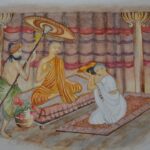
In Pāṭaliputta, the plea found its answer in the heart of a woman who had already transcended the world: Sanghamittā Therī, the enlightened daughter of Emperor Ashoka and the sister of Arhant Mahinda. Though she was a royal princess, her true kingdom was the discipline of the monastic life.
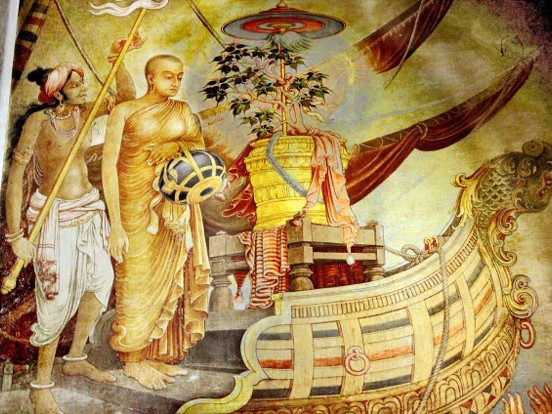
Ashoka, moved by the silent call of the island women and the resolve of his daughter, offered the most sacred gift possible: a sapling of the Jayasrī Mahā Bodhi—the tree of the Buddha’s own awakening. With a golden knife, he separated the southern branch, which miraculously sealed itself in a massive golden vase.
Sanghamittā Therī did not travel alone. She gathered a devoted retinue—not just of wise Bhikkhunīs, but also the eighteen castes of artisans—gardeners, potters, carpenters, and physicians. This was not just a spiritual mission; it was a civilization mission. She carried the seeds of Enlightenment and the roots of high culture.
The Voyage of Trust
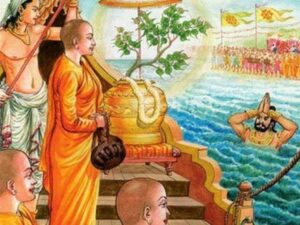
The journey was long and perilous. The immense Bodhi vessel, bearing the destiny of an entire nation, sailed the waves. When the ship finally approached the shores of Dambakolapaṭṭana on the day of the Unduvap Full Moon, the sea itself seemed to calm its breathing.
On the beach, the atmosphere was thick with anticipation. King Devānampiyatissa, casting off the robes of a monarch, waded into the water up to his neck, showing the depth of his reverence. He offered the kingdom’s sovereignty to the Bodhi Tree, recognizing its supremacy over all earthly rule.
The King and the people welcomed the procession with music, flags, and hearts overflowing. The Bodhi sapling was carried, canopy shaded, across the island to its final, sacred resting place: the Mahāmevunāwa Garden in Anurādhapura.
The Planting and the Promise
As the sapling was gently placed into the prepared earth, it was more than an act of gardening; it was the re-planting of the Dhamma itself. The very air shifted. From that moment, Lankā gained a living, breathing connection to the moment of the Buddha’s perfect realization.
But the story of Unduvap did not end with the tree. The next day, Queen Anulā and her 500 companions gathered. Before them stood Sanghamittā Therī. With solemn ceremony and deep compassion, the Therī conferred the Higher Ordination (Upasampadā).
The yearning was fulfilled. The women of Lankā, now the first Bhikkhunīs of the island, joined the noble path, empowered to achieve their own liberation.
The Undying Legacy
The day of Unduvap remains our final Poya of the year, marking not an ending, but the completion of a sacred circle. It reminds us:
- Of the enduring stability of the Dhamma: The Jayasrī Mahā Bodhi, still thriving after more than two millennia, is a beacon of this truth.
- Of the universal compassion of the Buddha: That the path to release is open to all—man, woman, king, and commoner—a promise made tangible by the establishment of the Bhikkhunī Sāsana.
On this auspicious day, we remember Sanghamittā Therī, the sister who crossed the sea, bearing not just a seed, but the light of spiritual equality, ensuring that the lamp of the Dhamma would shine in every heart upon the island.
Dr Damenda Porage