We pause to reflect upon the life of Queen Anulā, whose spiritual hunger illuminates the deepest connection between Bhārata and Lankā. Her story is a testament to the truth that the Dhamma recognizes no borders, only hearts ready to receive its light. Before the coming of Sanghamittā Therī, the island of Lankā had been blessed by the Bhikkhu Saṅgha, yet …


We pause to reflect upon the life of Queen Anulā, whose spiritual hunger illuminates the deepest connection between Bhārata and Lankā. Her story is a testament to the truth that the Dhamma recognizes no borders, only hearts ready to receive its light.
Before the coming of Sanghamittā Therī, the island of Lankā had been blessed by the Bhikkhu Saṅgha, yet the path of higher ordination (Upasampadā) remained inaccessible to women. Queen Anulā, a royal consort, was not content with mere devotion; she craved realization. Her spirit was parched, her mind restless with the incomplete journey.
She represented the collective longing of all Lankā’s women—a pure, unwavering desire to embrace the full monastic discipline and attain the ultimate goal of Nirvana. This profound spiritual thirst was the very force that pulled the sacred from the mainland to the island.
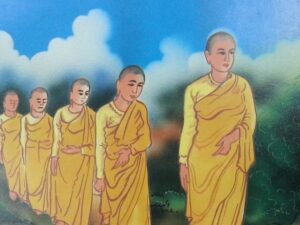
Queen Anulā’s devotion triggered a direct plea to the source of the Dhamma, Emperor Ashoka in Bhārata. Her simple, earnest request was the catalyst for the greatest act of spiritual sharing between the two nations: the voyage of Sanghamittā Therī and the arrival of the Jayasrī Mahā Bodhi.
The journey, undertaken on the Unduvap Poya day, was not merely a diplomatic exchange; it was the establishment of a spiritual kinship—an acknowledgment that the welfare of Lankā was deeply entwined with the compassion radiating from Bhārata. The two lands shared not just trade routes, but the Buddha’s heritage.
When Queen Anulā finally received her Higher Ordination from Sanghamittā Therī, her personal journey became an epochal moment for the nation. She transformed from a seeker into a torchbearer. Her liberation opened the doors for countless others, ensuring that the four pillars of the Sāsana (monks, nuns, laymen, and laywomen) were firmly rooted in the island soil.
Anulā’s story teaches us that sincere aspiration is never abandoned. It also reminds us that the enduring bond between Bhārata and Lankā is one founded on the highest spiritual ideals—a tradition of giving and receiving the Dhamma that continues to enrich both cultures today.
Queen Anulā’s deep-seated yearning for ordination was the force that completed the structure of the Sāsana on this island, cementing the four pillars of the Buddhist community. Her personal liberation became the liberation of a generation. However, this profound legacy—the Bhikkhunī Sāsana—faced decline in later centuries. As we venerate the memory of her courage and the compassion of Sanghamittā Therī on this Unduvap Poya, we carry a sacred duty: to actively uphold the principle of spiritual equality that defines this day. The continued flourishing and support for the full monastic community, including the revival and sustainability of the Bhikkhunī Order, is not merely a historical footnote but a contemporary act of Dhamma practice. May the unwavering faith of Queen Anulā inspire us to nurture this complete heritage, ensuring the whole of the Buddha’s path remains illuminated for seekers in every generation to come.
Dr. Shermila Milroy